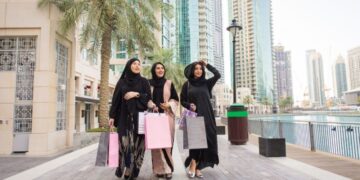


Dubai’s multinational workforce is one of the most extraordinary forces on earth, quietly and powerfully changing how the city eats, dresses, and does business every single day.
A city built on many cultures
Walk through any neighbourhood in Dubai and you hear at least 5 languages before you reach the end of the block. As of early 2026, Dubai’s population is estimated at around 3.94 million, with more than 88% made up of expatriates. There are more than 200 nationalities living and working in the UAE. That is not a marketing line. It is the lived reality of daily life here.
Native residents make up only about 7.98% of Dubai’s population. Indians represent the largest group at around 30 to 38%, followed by Pakistanis, Bangladeshis, Filipinos, and Egyptians. Europeans, Africans, and people from the Americas fill in the rest. Every single one of these communities brings something new to the city, and the city absorbs it, adapts, and grows stronger.
Government initiatives, including long-term residency programs and golden visas, continue to support talent attraction and retention, reinforcing Dubai’s position as one of the most competitive job markets worldwide. This is a city that actively designs itself to welcome the world.
Food: a table with 200 seats
The most immediate place you feel Dubai’s diversity is at the dinner table. The third annual Dubai Gastronomy Industry Report, published in April 2025, revealed that the city’s food and beverage sector is on a steady upward trajectory, with 1,200 new restaurant licences issued to operators. Think about that number for a moment. Over a thousand new restaurants, each one reflecting a community, a tradition, a home country.

Dining out is a regular activity, with Dubai residents visiting restaurants 2.5 times per week on average. When they do eat out, the diversity of cuisines is a top priority for diners. The DET’s ‘Gastronomy Always On’ report found that 49% of respondents considered the type of cuisine as the most important factor when selecting a restaurant. That demand drives innovation at every level, from street food stalls to fine dining.
In 2025, chefs are doubling down on authenticity. Restaurants like Arabian Tea House are serving Emirati classics, while Indian thalis, Persian stews, and Levantine mezze are presented in their truest forms, creating a dining experience that feels both globally rich and deeply local. The multinational workforce is not just cooking this food. It is the audience that demands it be done well.
Fashion: a runway shaped by many hands
Fashion in Dubai follows a similar pattern. The city’s clothing market draws from South Asian textile traditions, European luxury standards, and Gulf regional aesthetics all at the same time. Fashion held 22% of the UAE e-commerce market in 2024, while food and beverage is advancing at a 15.2% compound annual growth rate to 2030. Both sectors grow because the people who live here come from everywhere.
Designers who relocate to Dubai bring their home-country aesthetics with them. A Nigerian designer in Al Quoz, a Korean stylist in Jumeirah, an Italian pattern-maker in Dubai Design District: each one adds a layer to what Dubai fashion means. Dubai Fashion Week scaled from 50,000 to 65,000 visitors, with over 2,500 fashion activations and international participation turning attention into retail results.






The UAE e-commerce market currently stands at USD 11.05 billion in 2025 and is projected to reach USD 20.54 billion by 2030, advancing at a 12.39% compound annual growth rate over 2025 to 2030. A large part of that growth comes from a shopper base that is global by nature, buying across categories that no single culture alone would define.

Expert perspective on Dubai’s workforce economy
Dubai’s strength is not simply that it attracts people from around the world. Its real advantage is that those people bring active economic behaviour with them. They open businesses, they spend in ways that reflect their home cultures, and they create entirely new market segments that did not exist before. The food sector is a clear example: a community arrives, it wants familiar ingredients and flavours, and suddenly a supply chain, a restaurant category, and a retail niche are born. The same logic applies to fashion and finance. Diversity here is not a background condition. It is the operating engine of three of Dubai’s most important industries. Each new nationality adds a new layer of demand, a new set of skills, and a new connection to global markets that Dubai would not otherwise have.
Industry perspective, finance and economic development professionals in Dubai
Finance: global talent, global capital
No sector shows the impact of the multinational workforce more clearly than finance. Dubai has been categorised as one of only 8 cities globally to possess broad and deep capabilities across all parts of the finance industry in the Global Financial Centres Index, standing alongside cities like London, New York, and Paris.
DIFC’s greatest strength remains its talented workforce, which grew to 50,200 financial services professionals. The centre created 4,122 new jobs in 2025, up 9%. These are not just numbers. They represent analysts from Singapore, compliance officers from Frankfurt, wealth managers from Mumbai, and fintech founders from Nairobi, all choosing Dubai as their base.
Companies in the Dubai International Financial Centre created over 4,100 new jobs during the first half of 2025, strengthening Dubai’s position as a global hub for financial professionals. The centre is now home to more than 85 hedge funds, which have grown 72% over the last 12 months and include 69 billion-dollar funds. The capital that flows through Dubai does so because the professionals managing it chose to be here.

Conclusion: where the world comes to build
Dubai’s multinational workforce is not a side feature of this city. It is the foundation. Every restaurant that opens, every fashion brand that expands, every financial firm that registers here does so because an international person decided to build something in this remarkable place. Dubai’s gastronomy excellence aligns with the city’s broader economic vision outlined in the Dubai Economic Agenda 2033, which aims to double the size of Dubai’s economy in the decade up to 2033. Food, fashion, and finance are 3 of the clearest windows into that vision. Whether you are visiting Dubai for the first time or returning for the tenth, look around you. The multinational workforce you see is the city itself, alive and in motion.

Discover more about multinational workforce
- Dubai International Financial Centre (DIFC) News
- UAE Food Service Annual Report (USDA Foreign Agricultural Service)
- Dubai’s Restaurants Tell Its Story (Emirates 24|7, 2025)